
Walk, Don't Run: Inside Toronto's Fastest-Growing Soccer League
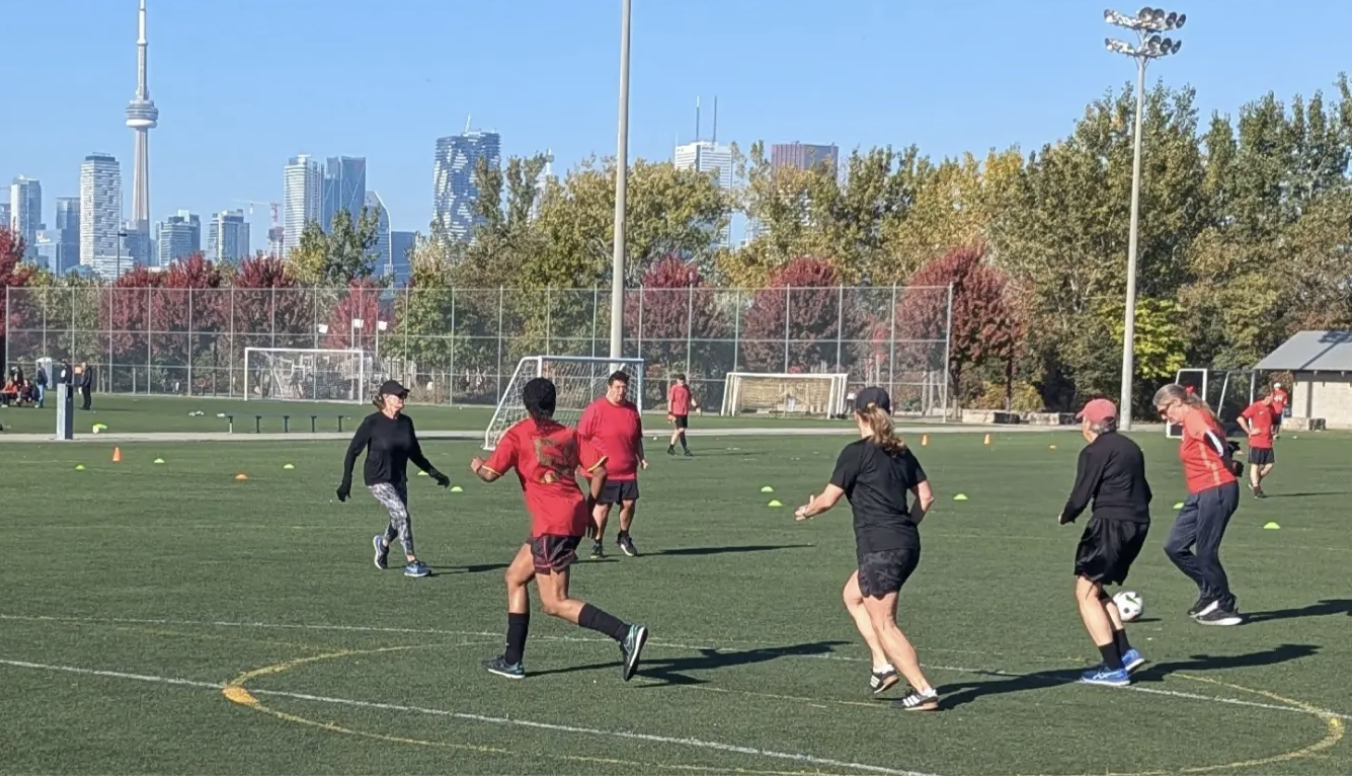
Image courtesy of Toronto Walking Soccer
In Toronto, one of the fastest-growing versions of the beautiful game has one rule, and it's the opposite of every other version of the game: walk.
This month, Blake from our team chatted with Aidan Butterworth - a former professional soccer player, co-lead of Parkinson's United, and overall lovely fellow. Parkinson's United is a free Toronto pilot walking soccer league created specifically for people living with Parkinson's.
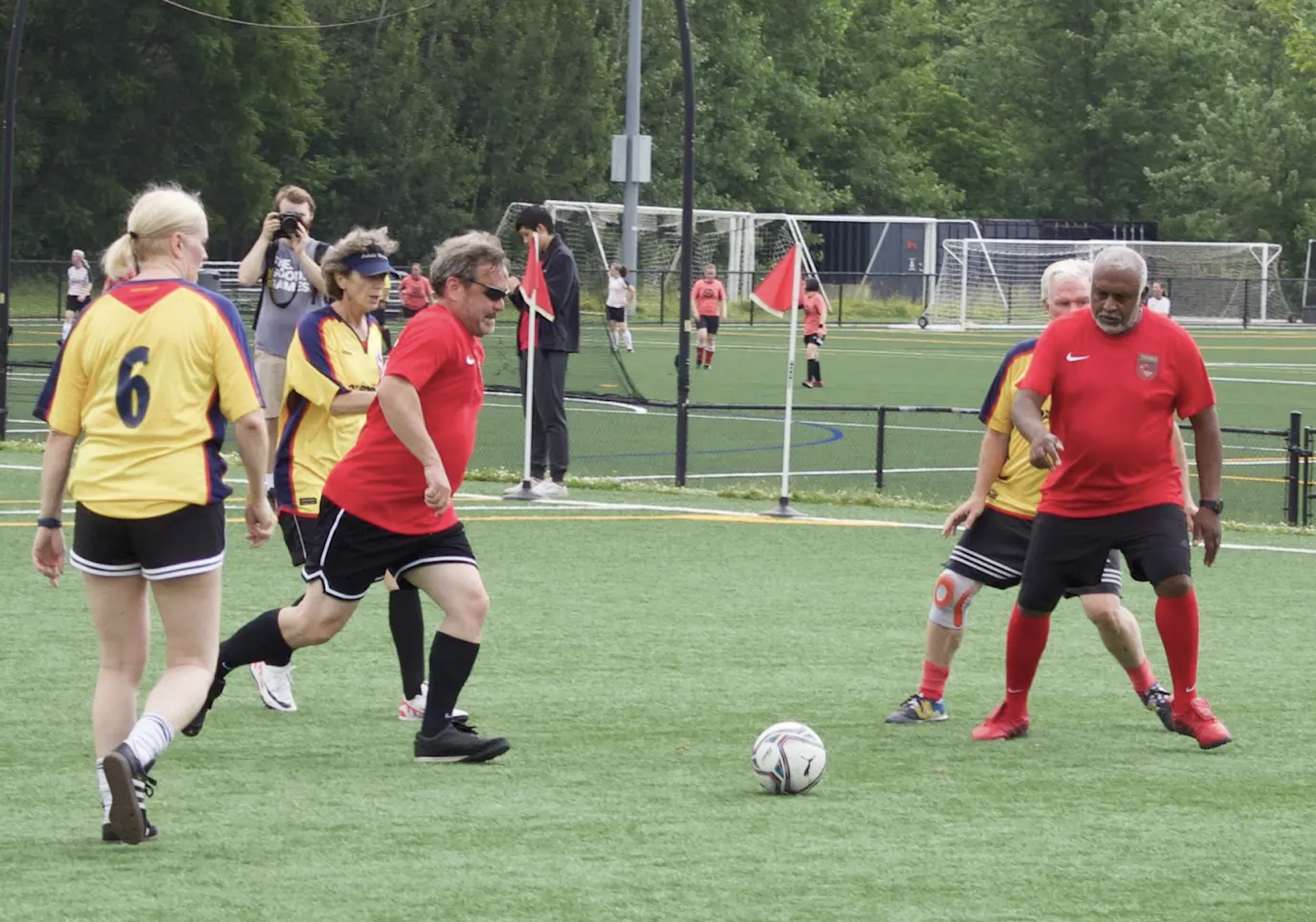
Image courtesy of Toronto Walking Soccer
Introducing the Toronto Loons & Parkinson’s United
Parkinson's United was created in partnership with the Passion for Parkinson’s Foundation and the Toronto Loons — a non-profit, volunteer-led walking soccer club founded in 2023 with over 230 members, welcoming women 40+ and men 50+, and the first and only walking soccer club in Toronto, home of Canadian Walking Soccer. The idea: make soccer more accessible.
Many players have little to no experience playing soccer prior to joining. Aidan described how he developed this program to be based upon movement, coordination, ball exercises and learning football skills and techniques with the focus on fun and encouragement..
Walking soccer came to Toronto on the strength of its success in Australia, Africa and the UK, where participation has exploded to around 120,000 people playing each week — there's a reason so many people take part.
Players "almost don't realize you're having a really good workout." A 2-hour session of dribbling, getting open, playing defense, and scoring goals gets moving a generation where 92% are not reaching the recommended weekly activity target.
Many Parkinson's United players find that walking soccer helps their mobility. Aidan described it as "absolutely fantastic" to watch the improvement of movement participants gain through the exercise.
"People might have tremors, they might not have the best mobility, but when they play, their movement becomes a lot more fluid"
Community building is a major aspect of taking part amongst players. 43% of Canadians 50+ are at risk of social isolation and 59% experience some degree of loneliness. For those living with Parkinson’s, the risk of social isolation is even higher.
The Toronto Loons and Parkinson's United address this directly as a team sport. There are very few activities for older adults that have the social dimension of being part of a team.
"You've got the shared responsibility, you've got passing, you've got moving, you've got the social aspect — there's no greater feeling."
It's this team approach that considers the whole person, something easily forgotten in prescriptions of solitary exercise and stretching. Community, connection, communication, and belonging are health aspects too often set aside.
Fittingly, the socialization it generates creates its own problem at warm-up time: "It's a hell of a job getting people on the pitch because they're all chatting and laughing."
Barriers that Walking Soccer Faces
Making walking soccer available to everyone isn't a walk in the park. Toronto's limited soccer-pitch infrastructure means high competition for space, especially in winter, when the cold pushes play indoors and fields are even harder to come by.
Money can be tight, too. Keeping programming costs low for participants remains a challenge: "Being a non-profit, we can't go on ad infinitum to subsidize it… but that's why we have a real need for grants and sponsorships".
Aidan's mindset, though, is shared by many of his generation: "It's pointless moaning and bellyaching about it, we just have to get on with it." That head-down attitude carries many non-profits through — but it takes a village to grow. Throughout the interview, Aidan kept thanking those who built Toronto Loons and Parkinson's United: the first three people who showed up at Cherry Beach, the volunteers who built the website and made t-shirts, and those connecting walking soccer to other Ontario cities. With community, challenges get easier to face.
More than sport
When asked for one takeaway: "Walking soccer should be on the agenda of every single city in the world as a health program. It delivers so much more than just the health benefits, although they are profound. This aspect of being part of something unique, and having that sort of positive mental attitude as well — I think that has to be one of the major benefits."
The future for walking soccer? Promote it throughout Canada, and take the Parkinson’s united model to other areas such as dementia and heart rehab.
Toronto walking soccer is a prime example of the essence of what grassroots sports should be. It stands for "accepting everyone, giving them a positive experience, and investing in them as people."
"It's more a question of sharing the joy… the reason I did this was to mirror best practice in Canada, to get everyone sharing the process and positivity, because I'm convinced that this can make a profound positive difference to people's lives."
You can learn more about the Toronto Loons and Parkinson’s United on their websites and sign yourself or a loved one up to participate.
