
Beyond the Pitch: What the World Cup Can Teach Canada About Sport as a Human Right
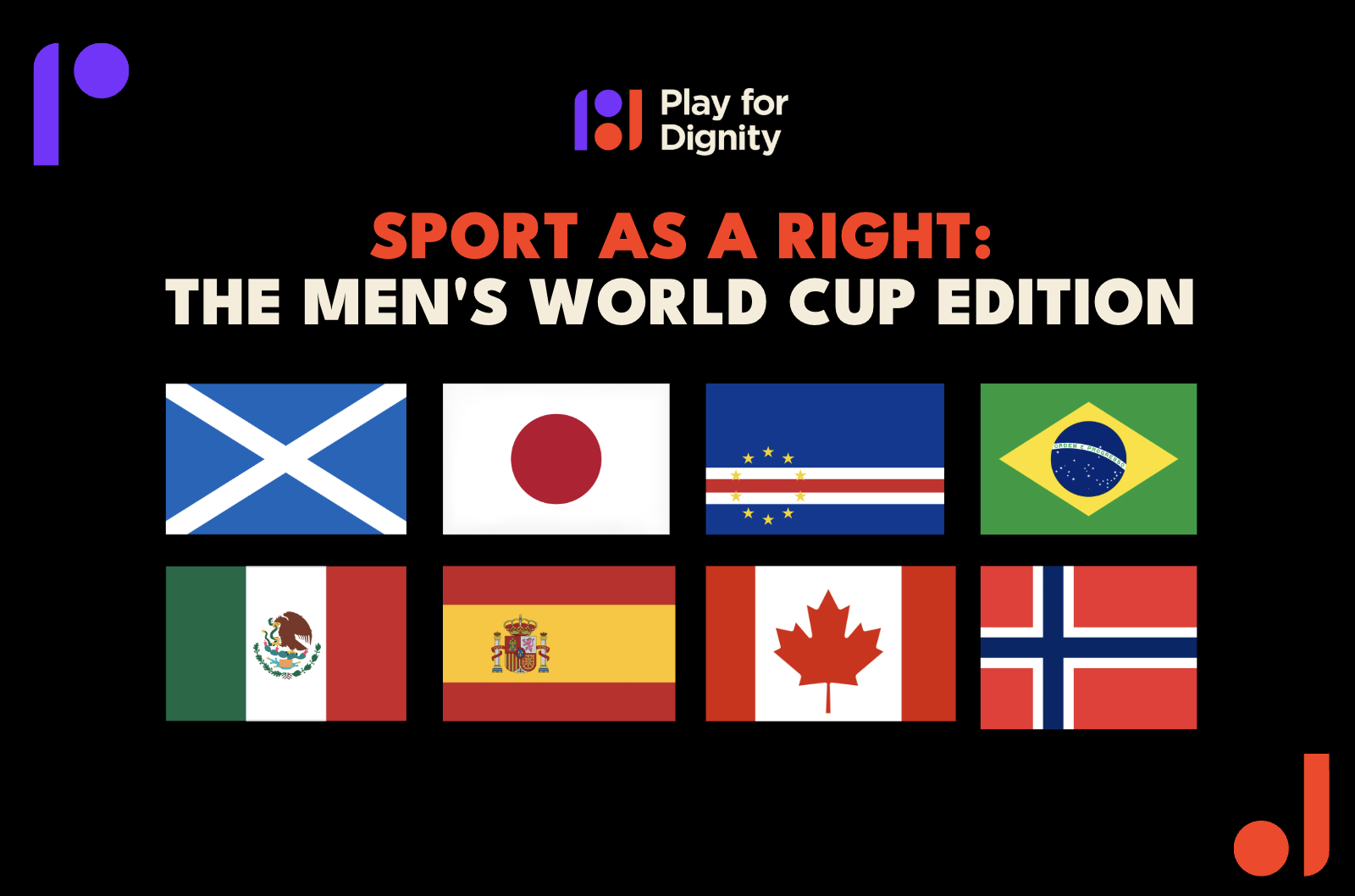
The World Cup always delivers unforgettable moments of triumph and defeat. With the tournament wrapped up, we want to look at a different kind of victory: the different ways jurisdictions around the world recognize access to sport and play, protect rights within sport, and use sport to advance broader human rights.
At Play for Dignity, this is the core of our work. Throughout the tournament, we took a virtual tour across seven countries featured in our World Cup series to examine what they have formally recognized, how they put those commitments into practice, and what Canada can learn from them.
Scotland:
Most countries celebrate the athletes they produce; fewer write down what they owe the children who might one day become them. In 2024, Scotland became the first developed nation in the UK to incorporate the UN Convention on the Rights of the Child into domestic law. Since July 16, 2024, public authorities acting under powers created by Acts of the Scottish Parliament or common law must comply with the incorporated UNCRC requirements. That binding legal step sits alongside an earlier policy commitment. Scotland's 2013 national play strategy set a goal of play with variety, adventure, and challenge, recognizing the importance of unstructured, self-directed play in a child's life. Scotland therefore demonstrates two distinct but complementary layers: a binding children’s rights framework and a national policy intended to support children’s everyday access to play.
Japan:
Japan explicitly recognizes sport as a statutory right, rooting it in community and everyday well-being. Its 2011 Basic Act on Sport declares that “living a happy and prosperous life through sport is the right of the people.” Article 2 calls for people to be able to participate voluntarily and autonomously throughout their lives, while the preamble describes sport as a universally shared human culture. Amendments that entered into force in 2025 went further, expressly seeking to give practical effect to the right to sport through stronger provisions on equal opportunity, safety, accountability, and fair dispute resolution. Radio Taiso offers a vivid example of how physical activity can become part of everyday life. First broadcasted in 1928 and still heard at 6:30 each morning, the accessible calisthenics routine continues to bring millions of people together in parks, schools, workplaces, and homes. Sport here is a daily act of belonging, connecting individual well-being with community life. Radio Taiso does not, on its own, tell us whether everyone can exercise the statutory right equally. It does, however, illustrate how physical activity can become an accessible and shared part of a country’s culture.
Cabo Verde:
As the smallest nation in the tournament, they uniquely enshrine sport directly into their constitution. Cabo Verde makes the right explicit. Article 80 of its Constitution recognizes everyone' s right to physical culture and sport. It also assigns public authorities responsibilities, working with associations, schools, sports organizations, and other actors to support participation and develop sporting infrastructure. A 2017 framework law adds principles of universality, equality, coordination, ethics, and transparency to the country’s sports system. This combination: a constitutional right corresponding to public duties and rules for implementation, shows why recognition and implementation must be considered together. A right can be written on paper; duty bearers, institutions, and accountability systems help determine whether rights holders (all of us) can actually experience it.
Brazil:
Brazil’s story moves from the right to participate in sport to rights within sport. Pelé’s generation played under the “passe” system, which could leave professional footballers tied to their clubs even after their employment contracts ended. The 1998 Pelé Law, developed while Pele serves as Minister of Sport, dismantles that system by connecting a player’s sporting registration to the employment relationship. When the contract ends, the sporting bond ends with it. The law gave players greater freedom to negotiate with other clubs and brought their treatment closer to that of other workers. The lesson is sports’s human rights dimension is not only about access to the field. It also includes labour rights, freedom, and dignity of the people whose work sustains sport.
Mexico:
Mexico builds the right to sport directly into its constitution. Article 4 now states that every person has the right to physical culture and the practice of sport, a right added through a 2011 constitutional reform that made it official. A follow-on law, the Ley General de Cultura Física y Deporte (2013), put the right into practice, assigning responsibility concurrently to the federal government through CONADE, state governments, municipalities, Mexico City’s territorial authorities, and actors in the social and private sectors. At the local level, Mexico City’s Ponte Pila program provides one example of implementation, offering free community physical activities in public spaces across the capital. It is a Mexico City initiative, not a national CONADE program and shows how a nationally recognized right can be supported through local delivery. Furthermore, Article 60 of the Ley General de los Derechos de Niñas, Niños y Adolescentes gives children the right to rest, recreation, play, and age-appropriate activities, as well as the freedom to participate in cultural, sporting, and artistic activities. It goes a step further and identifies duty bearers responsible for upholding it including those raising a child, not just the state. Notably, respect for these rights must be protected against encroachment from work, study, or discipline that may crowds them out.
Spain:
Spain shows another path to rights-based sport, built on law. Its 1978 Constitution framed sport as a duty of public authorities, but the new Ley 39/2022 del Deporte turned that into a statutory right of every person to practise physical activity and sport. The system is decentralized: the responsibilities are distributed among the national government, 17 autonomous regions, and municipalities who run about 93% of facilities. The centralized sport entity, the Consejo Superior de Deportes coordinates efforts across this ecosystem. The results show in their participation, which reached 62.7% of people annually in 2024/25, with the gender gap shrinking from 12.3 points in 2015 to 6.7. Much of the law's force is in its protections for women: contract clauses permitting termination because of pregnancy are null, federations must adopt protocols against harassment, events organized, commissioned, or financed by public authorities must provide equal prizes for women and men. LGBQTI+ rights are also written in, including privacy protections for trans and intersex minors. Spain shows how a statutory participation right can be accompanied by specific protections for equality, dignity, and safety within sport. .
Norway:
Norway is a powerhouse of joy, where children’s enjoyment of sports is deliberately prioritized over just winning. It is also a powerful example of different layers of rights recognition working together. At the level of national law, Norway incorporated the UN Convention on the Rights of The Child in 2003. The Convention applies as Norwegian law and prevails when it conflicts with other legislation. That includes Article 31, which recognizes every child's right to rest, leisure, play, recreation, and participation in cultural life. Norway therefore does have a legally recognized right, but it is group specific, belonging to children rather than a universal national right to sport for everyone. Given its impact on the life and culture of Norway, the practical effect is that once opportunities are secured for the most vulnerable, they continue as the population ages. Within organized sport, the Norwegian Olympic and Paralympic Committee and Confederation of Sports has translated children's rights principles into binding sector rules for its affiliated organizations. Children have eight defined rights, including the right to safety, friendship and enjoyment, participation in decisions, development at their own pace, and freedom to choose which and how many sports they play. The competition rules allow rankings beginning in the year a child turns 11 and prohibit Norwegian, European, and world Championships through the year a child turns 12. Sports federations must establish sanctions for violations, although there is no single universal sanction amount applying across every single sport. A separate joint commitment involving government, municipalities, and voluntary organizations aims to give every child the opportunity to participate regularly in at least one organized leisure activity, regardless of family circumstances. Norway’s lesson is not simply that children should play for joy. It is that legal recognition, enforceable sector rules, access commitments, and accountability mechanisms can reinforce one another to help children experience their rights in practice.
You can catch up on all our country's spotlights over on our Instagram page.
Bringing the Movement Home to Canada
Across this World Cup series, we have seen that there is no single route to rights-based sport. Some countries establish explicit constitutional or statutory rights. Others rely on incorporating international rights, public duties, national policies, independent institutions, or binding rules within the sport system.
Formal recognition matters, but it is not enough on its own. Rights are more likely to be experienced when commitments are supported by coherent policy, accessible programs, capable institutions, sustainable funding, inclusion measures, accountability, and public measurement. Conversely, a constitutional promise can remain distant from people’s lives when those systems are missing.
Canada does not need to copy any one country. It can draw from the strongest elements found around the world to build a coherent system of its own: one that expands the right to participate, protects right within sport, and uses sport responsibly to advance rights throughout society.
This is part of a growing global movement, and there is a place for you in it.
Here is how you can get involved today:
Sign up to our newsletter to get updates on our advocacy work.
Follow us on Instagram to stay tuned for more content series like this.
Send your questions, or suggestions to info@playfordignity.ca.
