
On November 20, the UN Convention on the Rights of the Child turns 37. It already says children have a right to play. Here is what happens when a city, a coach and a country take that seriously.
Ask a child in Hamilton, Ontario what their rights are and you may hear about the big slide.
When more than 2,000 of the city's children and youth were asked to describe their rights in their own words, they talked about swings at the park, bigger parks, sports, dance, clubs and having a best friend. Their answers became Hamilton's Charter of Rights of Children and Youth. One line reads: "I have the right to play."
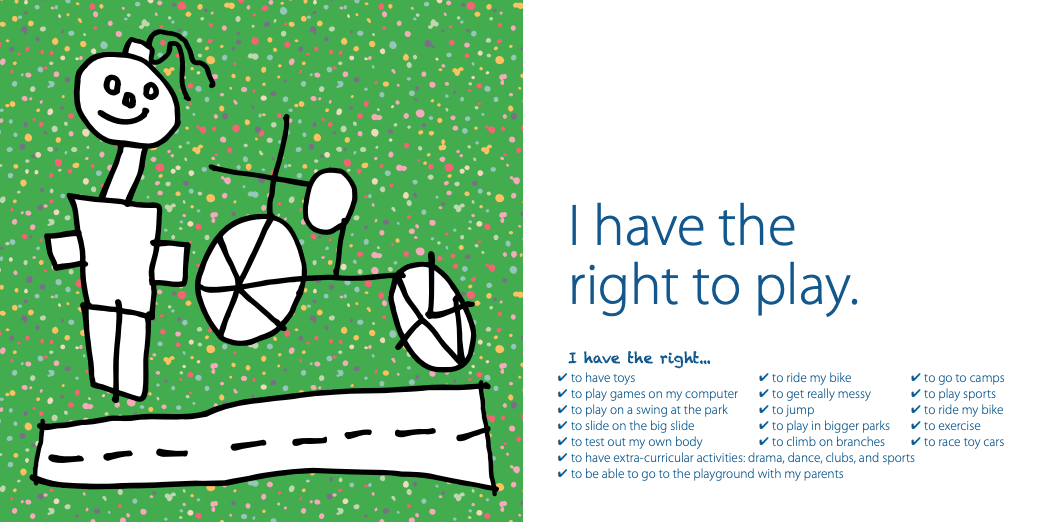
Image from Hamilton’s Charter of Rights Children’s Book; Created by John VanDuzer, WISHART.NET
Those children were describing, in their own terms, a promise their country made before any of them were born.
On November 20, 1989, the UN General Assembly adopted the Convention on the Rights of the Child. Today 196 countries are party to it. No other human rights treaty in history has been agreed to by so many governments. Canada ratified it in 1991.
November 20 is now World Children's Day. It is a good day to ask what that promise means for the places where children spend much of their childhood: fields, gyms, pools, rinks and playgrounds.
What the Convention says
The Convention has 54 articles. Article 31 recognizes every child's right to rest, leisure, play and recreation. Play is defined as activity children start, direct and shape on their own terms, and says time and space for it, and for rest, matter as much as organized activities.
It also includes rights that decide what a child's experience of sport is actually like: to be treated without discrimination (Article 2), to have their best interests come first (Article 3), to be heard on matters that affect them (Article 12) and to be protected from violence (Article 19).
Read together, they describe sport as most people already believe it should be. Every child gets to take part. Every child is safe. Every child has a say.
Liz Twyford has spent more than a decade at UNICEF UK working on children's rights in, around and through sport. She sees the same reaction whenever people meet the text for the first time. Many people imagine human rights as something distant, settled in courts and in crises. The Convention can sound abstract until its articles are connected to everyday decisions about children.
That reaction is the opportunity. The Convention gives sport a shared language that few disagree with once they have read it. The work is to apply those rights when deciding who gets access, how children are treated, and who is accountable when something goes wrong.
Hamilton: a charter written by children
The city's first children's charter was 15 years old when the Hamilton Best Start Network and Culture for Kids in the Arts set out to renew it. They went to EarlyON centres, schools, child care, youth programs and summer playground programs, and asked children from birth to 18 what their rights should be. Educators recorded the answers in words, drawings and pictures.
The city's stated ambition is to make Hamilton the best place to raise a child, and the best place to be a child.
Two things stand out for anyone working in sport.
First, the children put play and sport in the charter themselves. Asked what they need, the children named the park, the team and their friends alongside food, home and family.
Second, the charter pairs each right with responsibilities, for children and for adults. The charter sets out participatory responsibilities alongside each right, for children and for adults. The rights come with no conditions: every child holds them, whatever they do. Children do not have to earn their rights. Children are asked to include every other child in play. Adults are asked to provide time and places for both structured and unstructured play, and to trust children to take some risks.The authors,who helped who helped develop the Charter, found.
The lesson for sport organizations, clubs, and municipalities is to involve children in deciding what respecting their rights should look like and make adults' responsibilities clear in that regard.
The unique role of coaches
Children experience their rights in the everyday decisions adults make. In sport, coaches can help to realize those rights.
Imagine an ordinary Tuesday practice. The coach decides whether to ask the kids what they want to work on. That is the right to be heard. The coach decides what happens when a nine-year-old misses the shot. That is the right to be safe and treated with dignity.
No coach calls these rights decisions. Children feel them all the same, and they shape whether a child comes back next week.
Twyford offers advice that should be in every coach education course.
In the UK where Twyford is based, they’ve built a national campaign on that idea. Play Their Way launched in 2023, funded by Sport England and led by a coalition of organizations that includes UNICEF UK. It sets out to reach the country's 2.6 million coaches with what it calls child-first coaching, built on three Convention rights: to play, to develop and to be heard. In practice that means giving every child a voice in the session, real choices, and a path that fits them. They get practical tools, and an AI app with an aptly named ‘joy coach’ assistance.
Scotland: the promise as law
Scotland went furthest. On July 16, 2024, the Convention became part of Scotland’s law, making Scotland the first nation in the UK to incorporate it.
Public authorities must act compatibly with the Convention's requirements when exercising functions covered by the Act. Children and their representatives can go to court when they do. Councils, health boards and other listed bodies must report on what they are doing to comply.
For sport and play, that changes the conversation and a reporting duty is where this shows. Every Scottish council is a listed authority under the Act, and so is sportscotland, the national agency for sport. Every three years, each must publish a report on what it has done to make children’s rights real and what it plans to do next, along with a version written for children. The first reporting period closed on March 31, 2026. Children, families and advocates now have a The first reporting period ended on March 31, 2026. Those reports give children, families and advocates a public record of how decisions about sport and play measure up.
What Canada can do
Canada ratified the Convention 35 years ago and has not fully incorporated it into domestic law. In 2022 the UN Committee on the Rights of the Child urged Canada to pass federal legislation on children's rights. Canada's next report to the Committee was requested for January 2027.
That leaves a gap between the promise and the playground. Hamilton, England and Scotland show ways to put the commitment to work. Canadian governments and child serving organizations – including in sport, play, and movement – can act now..:
Use it as a mandate
Every government in Canada should start with Canada’s commitment to the UNCRC and Article 31. A municipality that funds recreation, a province that funds school sport and a federal government that funds national sport organizations have all agreed that play is a right. Advocates can start from that agreement.Use it as a standard
Any club, league or program can hold itself up against the Convention. Can every child take part? Is every child safe? Does every child have a say? Who is missing, what will we change, and where can a child turn to when something goes wrong?”Use it as a method of engagement
Hamilton asked 2,000 children what their rights should be. Any city, club or league can do the same before it builds a park, sets a fee or designs a program. The Lundy Model, developed by Professor Laura Lundy and used by Liz Twyford with sport bodies, sets four conditions: Space for children to speak, support for their Voice, an Audience that actively listens, and Influence, meaning their views are acted on and they hear what changed. It is built to reach every child.Introduce and reinforce it with coaches
Coach the child. Coaches need training, time and support. Clubs, governing bodies, funders and governments must also examine the fees, facilities, competition rules and complaint processes they control to create enabling conditions for Children's rights.
For us, at Play for Dignity, this is the foundation of our work: rights to sport, within sport and through sport.
The children of Hamilton have already told us what that looks like. It looks like the big slide, a team to play on and a friend to play with. And, nearly every country on earth has committed to that. This November 20, the job is to keep the commitment to the Convention, and help us deliver the true promise of sport.